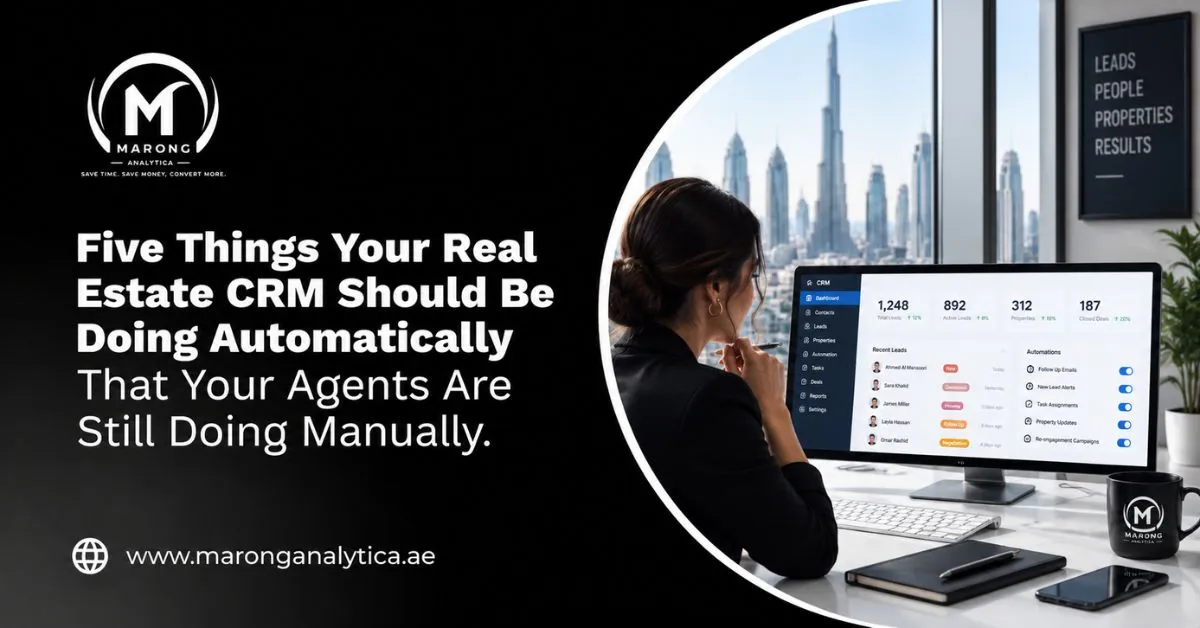
Five Things Your Real Estate CRM Should Be Doing Automatically That Your Agents Are Still Doing Manually
From our office at Level 11, Sobha Sapphire Building, Business Bay, Dubai, we spend a significant amount of time inside real estate brokerages across the UAE, looking at how they actually operate day to day.
One pattern repeats itself almost everywhere.
The CRM exists. It was purchased, set up, and introduced to the team with good intentions. Agents were trained on it. Management invested time in getting it configured. And then, quietly, it became a contacts database. A place to store names and numbers. A tool agents log into when they remember to, update when they feel like it, and largely work around the rest of the time.
Meanwhile, the tasks the CRM was supposed to handle are still being done manually. Agents are typing follow-up messages one by one. Managers are chasing pipeline updates in WhatsApp groups. Viewing reminders are sent when someone remembers to send them. Lead assignment is handled through manual decisions made under time pressure. And the old database sits untouched because nobody has the bandwidth to work through it systematically.
This is not a technology problem. The tools available for real estate CRM automation Dubai brokerages can access today are genuinely capable. The problem is that most CRM installations are configured for storage, not for automation. They are set up to hold data, not to act on it.
This article covers five specific things your CRM should be handling automatically right now that your agents are almost certainly still doing by hand, and what the cost of that gap looks like in a Dubai real estate context.
Why Manual Processes Break Down at Scale
Before getting into the five automations, it is worth being clear about why manual processes fail, because the failure is not usually visible until it becomes expensive.
When a brokerage has five agents and fifty active leads, manual processes are manageable. Agents can remember who to call, when to follow up, and which leads need attention. The pipeline is small enough to hold in your head.
When that same brokerage grows to twenty agents and three hundred active leads, the same manual processes collapse. Not because agents become less diligent, but because the cognitive load of managing a large pipeline manually is simply too high. Things get forgotten. Follow-ups slip. Leads fall through the cracks. And because the failures are invisible until the deal is lost, management has no early warning system.
CRM for real estate agents UAE brokerages actually rely on is not just a place to log calls. It is the operational layer that ensures every lead receives the right action at the right time, regardless of how busy the agent is, how many new leads arrived that day, or whether the agent remembered to check their pipeline that morning.
Here are the five things it should be doing automatically.
1. First Response to Every New Lead
The single most time-sensitive moment in real estate sales is the first sixty seconds after a lead arrives.
Research across sales industries consistently shows that leads contacted within five minutes of submitting an enquiry are dramatically more likely to convert than those contacted after thirty minutes or an hour. In Dubai real estate specifically, where portals like Property Finder and Bayut distribute the same enquiry to multiple brokerages simultaneously, the agency that responds first has a significant structural advantage over every agency that responds after.
Despite this, in most brokerages, the first response to a new lead depends entirely on whether an agent happens to be available, looking at their phone, and not already in the middle of another conversation. On a busy morning, a lead that arrives at 10:47am might not get a call until 12:30pm. By then, the prospect has already spoken to two other agencies.
What your CRM should be doing automatically is sending an immediate, personalised acknowledgement the moment a lead arrives, across WhatsApp as the primary channel, with the agent's name, a reference to the property or area enquired on, and a clear next step. Not a generic "thank you for your enquiry" template. A message that signals the agency has received the information, knows what the prospect is looking for, and is ready to help.
This automated first response does not replace the agent call. It holds the prospect's attention and establishes your agency as responsive while the agent prepares to make contact. It means the prospect is not sitting in silence wondering whether their enquiry was received, and it reduces the likelihood that they call a competitor in the gap.
Marong Analytica's AI lead response system handles this automatically for every inbound lead, across portal integrations and WhatsApp, with response times measured in seconds rather than hours.
2. Lead Qualification Through Structured Conversation
After the first response, the next task is qualification. Establishing budget, timeline, decision authority, and property criteria before an agent invests significant time in a prospect.
In most brokerages, this happens manually, inconsistently, and often incompletely. Some agents ask the right questions on the first call. Others jump straight to booking a viewing without establishing any qualification criteria at all. The result is a pipeline full of leads at various stages of readiness that nobody has assessed using the same framework.
Your CRM should be running a structured qualification sequence automatically, through WhatsApp conversation, before a lead ever reaches an agent's active pipeline.
This means asking specific questions in a logical order. Budget first, to establish financial readiness. Timeline next, to understand urgency. Decision-making structure, to identify whether other stakeholders are involved. And property criteria, to determine whether what the prospect is looking for actually matches what your agency can offer.
The responses to these questions should update the lead's profile in the CRM automatically, tag them by readiness level, and route them accordingly. A fully qualified lead with a confirmed budget, a defined timeline, and specific criteria should go directly to an agent's priority queue. An early-stage browser with no financial clarity and a vague sense of wanting to "maybe buy something next year" should go into a long-term nurture sequence, not an agent's active workload.
When this process is manual, qualification depends on the agent remembering to ask the questions, having time to ask them, and updating the CRM accurately with what they found. When it is automated, every lead gets the same structured assessment, and the data in your CRM actually reflects the true state of your pipeline.
For reference on qualification frameworks, HubSpot's breakdown of lead scoring models offers useful context on how automated qualification can be built into CRM workflows across industries.
3. Follow-Up Sequences Across the Full Pipeline
This is the automation gap that costs Dubai brokerages the most revenue, measured in absolute terms.
The average real estate transaction in any market closes after multiple touchpoints. Most agents in Dubai, under the pressure of new leads arriving daily, make one or two contact attempts on a lead and move on when they receive no immediate response. The lead is not closed. It is not marked as lost. It simply stops receiving attention.
What your CRM should be doing is running a defined follow-up sequence on every lead automatically, from the moment of first contact through to a defined outcome, whether that is a booking, a deal, a qualified disengagement, or a move into long-term nurture.
That sequence should include:
A same-day follow-up message if the first call goes unanswered. A WhatsApp check-in on day two with a relevant property or market insight. A structured message on day four that offers something of value rather than just asking if they are still interested. A re-engagement attempt on day seven. A longer-interval nurture message at day fourteen and day thirty for leads that have not responded but have not explicitly disengaged.
Every touchpoint in this sequence should be logged in the CRM automatically, with timestamps, channel, and outcome. The agent should only be brought in when the lead responds with genuine intent, at which point the CRM should surface the full conversation history so the agent arrives informed.
What actually happens in most brokerages is that agents manage their own follow-up manually, which means it is inconsistent across the team, stops after the first or second attempt for the majority of leads, and is never logged accurately enough to give management a true picture of pipeline activity.
The revenue implication is significant. Leads that would have converted after the fourth or fifth touchpoint are being abandoned after the second. Those leads do not disappear. They convert with the next agency that stays in contact long enough to be there when the prospect is ready.
Marong Analytica's automated follow-up and pipeline management system runs this entire sequence without agent input, escalating to a human conversation at the precise moment a lead re-engages with intent.
4. Viewing Reminders, Confirmations, and No-Show Recovery
A booked viewing and a completed viewing are not the same thing. The gap between them, in most Dubai brokerages, represents a significant proportion of wasted agent time every week.
Industry figures for the UAE real estate market suggest that somewhere between 25 and 35 percent of booked viewings result in a no-show or a last-minute cancellation. Across a team of fifteen agents doing three viewings each per week, that is roughly fifteen to twenty wasted viewings per week. Preparation time, travel time, and the opportunity cost of the meetings those agents could have been taking instead.
Your CRM should be handling the entire viewing confirmation workflow automatically.
The moment a viewing is booked, an automated confirmation should go to the prospect with the property address, the time, the agent's name and contact number, and a link to confirm attendance. Twenty-four hours before the viewing, an automated reminder should go out asking the prospect to confirm they are still attending and offering a simple reschedule option if their plans have changed. Two hours before, a final reminder with location details and the agent's number.
This sequence serves two purposes. It reduces no-shows by ensuring the viewing is front of mind for the prospect and by giving them an easy, low-friction route to reschedule rather than simply not showing up. And it gives the agent advance warning when a prospect is unlikely to appear, so they can make productive use of that time instead of driving to an empty property.
When a no-show does occur despite the reminders, the CRM should automatically trigger a recovery sequence. A message to the prospect acknowledging they could not make it, offering two alternative times, and keeping the conversation open rather than treating the no-show as a deal-ending event.
All of this currently happens manually in most brokerages, which means it happens inconsistently. Some agents send reminders. Others do not. Some follow up after a no-show. Others write the lead off. The inconsistency directly affects conversion rates and agent productivity in ways that are measurable but rarely measured.
Salesforce's research on sales automation impact consistently shows that automated reminder and confirmation workflows reduce no-show rates and improve pipeline conversion across sales-intensive industries. Real estate in Dubai is no exception.
5. Pipeline Stage Updates and Performance Reporting
Ask a Dubai brokerage manager how their pipeline looks this week. In most cases, they will tell you what their agents told them in the last team meeting. They will describe the hot deals, the viewings scheduled, the offers being negotiated. They will not be able to tell you how many leads have had no activity in the past ten days, which agents have the highest no-show rates, or what percentage of last month's portal leads converted past the first contact.
That information exists. It is sitting in the CRM, in a fragmented form, waiting for someone to compile it manually. Which nobody does, because compiling it manually takes hours that managers do not have.
Your CRM should be updating pipeline stages automatically based on activity, generating performance reports without manual input, and surfacing anomalies before they become revenue problems.
When a lead receives three follow-up attempts with no response, the pipeline stage should update automatically to reflect that status. When a viewing is confirmed, the lead should move to the appropriate stage without an agent needing to remember to update it. When a lead has been sitting in the same stage for more than seven days with no activity, the CRM should flag it as at risk and alert the relevant manager.
On the reporting side, every manager of a real estate sales team should be able to see, at any point, without asking anyone: average first response time by agent, follow-up compliance across the pipeline, viewing completion rates versus no-show rates, lead source conversion performance, and pipeline stage distribution showing where volume is accumulating and where deals are getting stuck.
When this data is available automatically, management decisions become faster and more specific. Instead of general conversations about working harder, managers can have targeted conversations about specific leads, specific stages, and specific behaviours. Training becomes more precise. Performance management becomes more objective. Revenue forecasting becomes more accurate.
This is the difference between a CRM that holds data and a real estate CRM automation Dubai brokerages can actually manage their business from. The data is the same in both cases. What changes is whether it requires a human to compile it or whether it surfaces itself in real time.
The Hidden Cost of Keeping It Manual
There is a temptation in many brokerages to treat manual processes as a cost-free alternative to automation. Agents are already being paid. The work gets done, eventually. Why invest in a system to do what people are already doing?
The cost of manual processes is not in the salary of the person doing them. It is in the errors, inconsistencies, delays, and omissions that accumulate when humans manage high-volume, repetitive tasks without systematic support.
A follow-up that was supposed to go out on day three but went out on day seven because the agent was busy is not a neutral outcome. It may be the difference between reaching a prospect while they are still undecided and reaching them after they have already committed elsewhere. In Dubai real estate, where commission values are high and competition is intense, that timing difference has a monetary value.
The five automations described here are not luxury features for large brokerages with enterprise budgets. They are the operational baseline for any brokerage that wants to convert its leads at the rate its marketing spend deserves.
Find Out What Your CRM Should Be Doing That It Currently Is Not
Marong Analytica audits real estate brokerage operations across Dubai and the UAE, mapping the gap between what the current CRM setup handles automatically and what is still being done manually by agents who should be spending that time closing deals.
We offer a free Lead Leakage Audit that shows you exactly where your pipeline is losing revenue, which processes are creating the biggest gaps, and what a fully automated system would mean for your monthly conversion numbers.
No generic presentation. A specific look at your setup, your agents, and your pipeline.
Book your free Lead Leakage Audit here
Or reach out directly:
📍 Level 11, Office 1104, Sobha Sapphire Building, Business Bay, Dubai, UAE
Marong Analytica builds AI-powered lead conversion, CRM automation, and sales systems for real estate brokerages across Dubai and the UAE. Level 11, Office 1104, Sobha Sapphire Building, Business Bay, Dubai, UAE.
