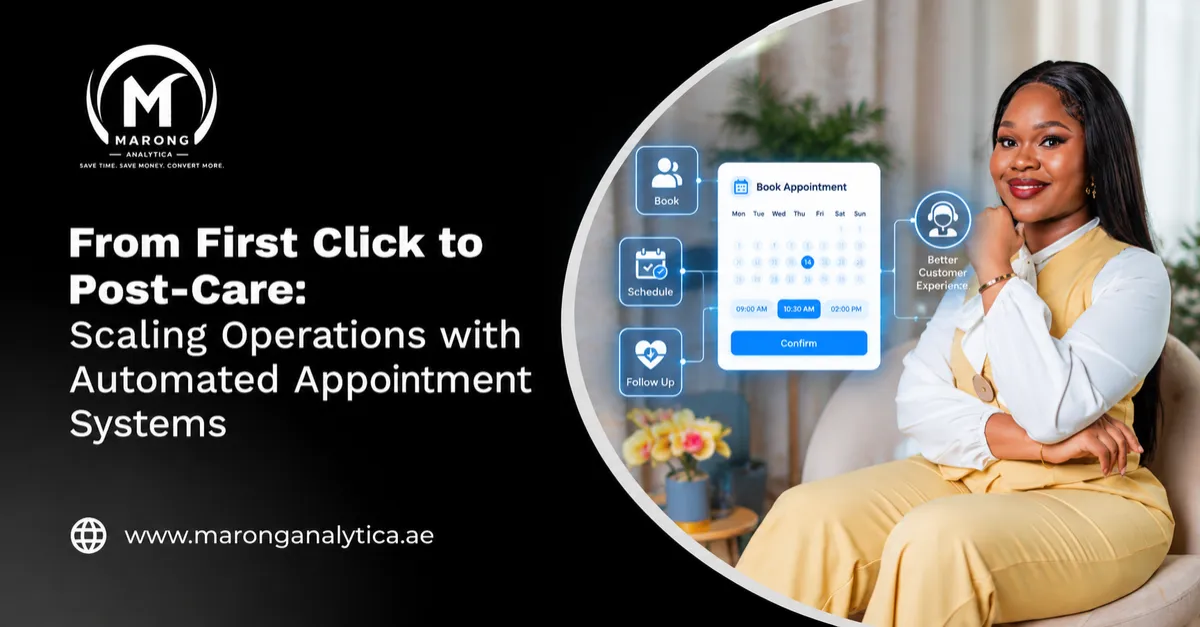
From First Click to Post-Care: Scaling Operations with Automated Appointment Systems
From our consulting suite at Level 11, Sobha Sapphire Building, Business Bay, Dubai, Marong Analytica works alongside healthcare providers, private clinics, commercial brokerages, and high-touch service enterprises across the UAE and the wider GCC region to re-engineer their client-handling systems.
A major operational bottleneck affects client-facing businesses across the region.
Organizations spend significant capital driving traffic to their digital channels and acquiring high-intent prospects. Yet, the moment a prospective client or patient decides to book a consultation, the journey encounters manual friction. Multi-step email exchanges, unanswered phone calls, delayed confirmation messages, and fragmented scheduling logs turn interested prospects into lost opportunities.
As an enterprise service agency, Marong Analytica builds and deploys end-to-end booking architectures that convert incoming digital interest into confirmed, attended appointments without adding administrative overhead. Scaling your appointment volume should not require scaling your administrative headcount.
This strategic guide details how integrating modern appointment scheduling automation across your client lifecycle stabilizes your schedule, reduces no-show rates, and elevates the end-to-end client experience.
The Hidden Cost of Manual Scheduling Friction
Before modernizing operational workflows, executive boards must evaluate the full financial impact of manual appointment management.
In traditional service environments, booking an appointment requires active administrative mediation. A client submits an inquiry form, an administrator reviews open calendar slots, contacts the client via phone or email, and manually writes the details into a schedule. If the client needs to reschedule, the entire manual coordination cycle starts over.
This manual reliance creates several key vulnerabilities:
Off-Hours Demand Drain: Up to 40 percent of booking requests occur outside standard office hours when administrative teams are offline.
High Appointment Drop-Off: Delays between initial inquiry and confirmation allow client intent to cool or direct them to faster-moving competitors.
Costly No-Show Rates: Unassisted scheduling leads to forgotten bookings, creating open calendar slots that directly erode revenue.
Deploying a custom-engineered appointment booking system eliminates these operational delays. By allowing clients to select, confirm, and manage their bookings through real-time self-service interfaces, enterprises capture demand the instant it surfaces.
Below are the key operational shifts required to automate your appointment lifecycle from first contact to post-care follow-up.
1. Capturing Instant Intent via Omnichannel Appointment Scheduling Automation
The journey from initial digital engagement to a booked consultation must be completely frictionless.
When an individual visits your portal, clinic page, or digital campaign, asking them to submit a generic contact form and wait for a callback introduces unnecessary hesitation. In fast-moving commercial hubs like Dubai, clients expect instant access to live availability.
Implementing custom appointment scheduling automation embeds dynamic, real-time availability into every client touchpoint—including your website, dedicated landing pages, WhatsApp channels, and mobile applications:
Live Calendar Synchronization: Displaying real-time open slots while automatically filtering out internal staff meetings and non-working hours.
Multi-Resource & Location Routing: Directing clients to the appropriate specialist, doctor, or consultation room based on specific service requirements.
Upfront Intake & Payment Integration: Collecting preliminary intake data and processing deposit fees before confirming the booking lock.
This seamless intake model converts initial curiosity into a confirmed appointment within seconds. To explore how we build direct response intake engines, review our AI Lead Response Systems page. For additional perspectives on digital patient and client access strategies, see Healthcare App Ecosystem Insights on Healthcare IT News.
2. Stabilizing Schedules with Multi-Touch Automated Appointment Reminders
Securing an initial booking is only half the operational challenge; ensuring the client actually attends the session is what drives revenue.
Across private healthcare clinics, legal practices, and commercial real estate brokerages, missed sessions represent a major operational drain. High no-show rates waste staff time, leave facilities underutilized, and disrupt daily revenue planning.
Deploying intelligent automated appointment reminders resolves attendance drop-offs by keeping upcoming sessions top-of-mind across multiple communication channels:
Instant Multi-Channel Confirmation: Dispatches structured calendar invites via WhatsApp, SMS, and email immediately upon booking.
48-Hour Confirmation Trigger: Sends an interactive notification requiring the client to explicitly confirm or request a time adjustment.
2-Hour Access & Parking Guide: Delivers location pins, building access codes, and parking instructions directly to the client's mobile device shortly before the appointment.
Automating these touchpoints dramatically reduces no-show rates while providing staff with early notice if a calendar block reopens—allowing the system to automatically offer that slot to waitlisted accounts. Explore our specialized Booking & Appointment Automation services to see how we help clients secure high attendance rates.
3. Elevating Retention Through Automated Appointment Follow-Up Automation
The client relationship does not end when the consultation or clinical visit concludes. The post-care and post-consultation window is critical for securing repeat visits, collecting feedback, and driving long-term client retention.
In manual operations, post-visit engagement is frequently neglected because administrative staff are already focused on managing the next wave of incoming appointments.
Integrating custom appointment follow up automation guarantees that every completed appointment transitions into a structured post-care workflow:
Immediate Post-Visit Surveys: Automatically dispatches feedback prompts via WhatsApp or email within hours of meeting completion.
Post-Care & Documentation Delivery: Automatically shares consultation summaries, post-treatment instructions, or legal agreement briefs.
Automated Recare & Rebooking Prompts: Triggers timely reminders for routine six-month checkups, periodic consultations, or contract renewals based on clinical or business rules.
By maintaining structured appointment follow up automation, service organizations increase long-term customer lifetime value without placing extra administrative demands on front-desk staff. Learn how our team custom-builds multi-touch nurture architectures on our B2B & Enterprise Nurture Protocols page.
4. Centralizing Operations with a Unified Enterprise Appointment Booking System
For multi-location medical centers, private hospital networks, and large-scale professional services firms, managing appointments across dozens of specialists and facilities requires absolute system coordination.
When scheduling data remains fragmented across branch-specific software or local calendars, management loses visibility into overall capacity utilization, cancellation trends, and practitioner productivity.
A centralized enterprise appointment booking system unifies all scheduling data into a single operational interface:
Cross-Facility Capacity Management: Balances client loads across multiple branch locations based on real-time room and practitioner availability.
Unified Client Interaction Profiles: Consolidates every booking, cancellation, reminder response, and post-visit survey into a single core record.
Custom Security & Compliance Layers: Implements strict data privacy controls and role-based access permissions to protect sensitive client information.
Integrating your scheduling architecture into a central control layer ensures operational consistency across every location. Take a look at our Custom Integration Frameworks capabilities to see how we unite legacy infrastructure with modern scheduling platforms. For broader standards on health system operations and patient scheduling, reference HIMSS Digital Health Insights.
5. Utilizing Real-Time Analytics to Optimize Operational Capacity
Optimizing appointment workflows requires executive leadership to make decisions based on clear operational metrics rather than subjective staff reports.
Relying on manual logs makes it difficult to track practitioner utilization, identify peak inquiry hours, or determine which marketing channels yield the highest attendance rates.
Modern appointment scheduling automation captures operational telemetry automatically, delivering clear insights through executive reporting dashboards:
Attendance & No-Show Telemetry: Tracks no-show trends by service type, practitioner, day of the week, and acquisition channel.
Capacity Utilization Rates: Measures actual consultation time versus open calendar slots to optimize staffing schedules.
Reschedule & Cancellation Patterns: Highlights specific touchpoints where clients frequently drop off or adjust booking times.
Communication Channel Efficiency: Evaluates whether WhatsApp, SMS, or email yields the highest response rates for automated appointment reminders.
Armed with continuous operational data, leadership can optimize practitioner schedules, reallocate marketing spend toward high-attending client segments, and eliminate scheduling bottlenecks. Review our CRM Reporting & Analytics Solutions to see how we deliver real-time operational visibility. For industry benchmarks on medical practice management, consult the Medical Group Management Association (MGMA) Research.
The Compounding Advantage of End-to-End Scheduling Architecture
In high-value service environments, appointment friction directly limits organizational growth. Operating with manual booking methods creates administrative backlogs, increases client drop-off, and leaves valuable facility capacity underutilized.
Deploying comprehensive appointment scheduling automation paired with proactive automated appointment reminders builds a stable, high-efficiency operational model. Your front-desk staff transition from answering routine scheduling calls to delivering high-touch, in-person client experiences.
Furthermore, integrating flexible appointment follow up automation ensures that every client engagement feeds into a continuous cycle of feedback, rebooking, and long-term loyalty—driving sustainable growth across your enterprise.
Partner with Marong Analytica to Modernize Your Booking Operations
Marong Analytica does not supply generic software templates. As a service-based engineering agency, we partner directly with corporate boards, medical directors, and operations managers across Dubai and the UAE to design, deploy, and maintain custom appointment architectures tailored to your operational needs.
We invite your executive team to schedule a dedicated Appointment Operations Audit. Our engineering group will evaluate your existing booking workflows, identify hidden no-show risks, and present a clear technical roadmap to automate your client journey from first click to post-care.
No high-level sales pitches. You will receive an actionable operational diagnostic built specifically for your organization.
Schedule Your Appointment: Operations Audit Here
Or connect directly with our operational engineering team:
📍 Level 11, Office 1104, Sobha Sapphire Building, Business Bay, Dubai, UAE
Marong Analytica is an enterprise service firm engineering custom appointment scheduling automation frameworks, automated appointment reminder systems, and high-velocity client-handling infrastructure for leading enterprises and medical centers across Dubai and the UAE.
