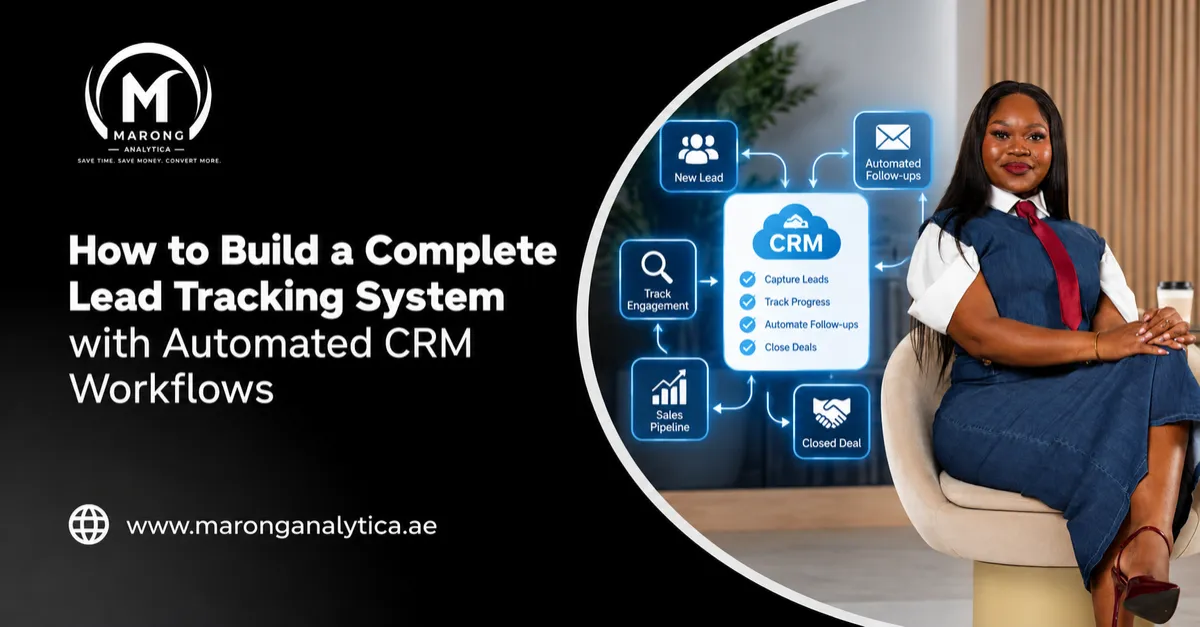
How to Build a Complete Lead Tracking System with Automated CRM Workflows
From our consulting suite at Level 11, Sobha Sapphire Building, Business Bay, Dubai, Marong Analytica works directly with managing directors, commercial leads, and enterprise operators across the UAE and broader GCC region to engineer high-performance revenue operations.
A quiet revenue drain undermines growing commercial organizations every single day.
Companies allocate substantial budgets toward multi-channel marketing, paid search acquisition, and industry networking. Inquiries arrive continuously across web forms, instant messaging, and direct emails. Yet, behind the scenes, these high-intent leads land in fragmented inboxes, unlinked spreadsheets, and personal messaging threads. Without a unified system, inquiries sit unassigned, follow-up messages miss critical deadlines, and prospective accounts vanish before an account manager ever makes formal contact.
As a service-based automation and integration agency, Marong Analytica builds and deploys end-to-end commercial architectures that turn disconnected touchpoints into structured, self-executing pipelines. Scaling revenue reliably requires replacing manual data entry with system-driven execution.
This operational guide details how constructing a centralized lead tracking system backed by intelligent CRM processes transforms static contact databases into high-velocity engines for business growth.
The Hidden Costs of Fragmented Lead Management
Before building a modern tracking stack, commercial leaders must recognize why manual lead tracking fails as business operations expand.
When a firm handles only a few new inquiries per week, reliance on manual tracking appears sufficient. Account executives record contact details in personal notebooks, manage schedules via standard calendar apps, and send follow-ups whenever administrative workload permits.
However, as lead volume increases and team size expands, manual tracking quickly creates operational friction:
Data Leakage & Silos: Prospective client records remain trapped in individual team inboxes, leaving leadership with zero pipeline visibility.
Response Delays: Manual lead routing causes hours or days of delay during peak intent windows, allowing agile competitors to win the account.
Inconsistent Cadences: Manual follow-ups vary wildly across team members, leaving large portions of the database unworked.
Implementing structured CRM lead management fixes these vulnerabilities. By unifying intake channels and automating stage transitions, enterprise firms ensure every prospective account undergoes identical, high-standard evaluation and timely engagement.
Here is how forward-thinking enterprises build an automated tracking infrastructure from the ground up.
1. Centralizing Inbound Capture into a Unified Lead Tracking System
The foundation of any high-performing commercial operation is complete capture visibility. An inquiry submitted through a web portal, an incoming WhatsApp chat, or a phone call must instantly feed into a single source of truth.
Allowing leads to sit in isolated channels creates administrative blind spots and delays initial engagement. In fast-moving markets like Dubai, prospective clients expect immediate acknowledgment and clear next steps.
Building a centralized lead tracking system connects all client-facing touchpoints into a unified data environment:
Multi-Channel API Aggregation: Automatically capturing and standardizing inquiries from web forms, digital ad campaigns, WhatsApp, and phone systems into core CRM profiles.
Real-Time Data Enrichment: Fetching firmographic data, corporate domain insights, and industry categories the moment an inquiry hits the system.
Duplicate Prevention Protocols: Merging incoming inquiries with existing account records automatically to prevent internal lead collision and chaotic outreach.
Centralizing inbound data creates absolute visibility across the top of your funnel. To see how our engineering teams construct high-velocity intake architectures, review our AI Lead Response Systems page. For additional perspectives on customer data integration and pipeline architecture, explore HubSpot's Customer Acquisition Research.
2. Eliminating Manual Entry Through Strategic CRM Automation for Small Business
For growing firms and mid-market service providers, administrative overhead is one of the highest hidden payroll expenses. Account executives routinely spend hours copying contact details between platforms, typing meeting notes, and manually updating deal stages.
When administrative burden consumes the majority of a salesperson's day, outreach frequency drops and deal velocity slows significantly.
Deploying targeted CRM automation for small business removes these non-revenue-generating tasks from team schedules:
Instant Triage & Dynamic Routing: Automatically assigning incoming leads to specific account pods based on geography, service line, or deal size within seconds.
Trigger-Based Task Generation: Creating required follow-up tasks and calendar holds automatically as accounts advance to new pipeline stages.
Automated Activity Logging: Recording incoming emails, client message responses, and document views directly onto the account timeline without manual logging.
Reducing routine data entry allows commercial teams to spend their time consulting with qualified prospects and closing agreements. Discover how our service teams streamline sales operations on our Sales Infrastructure Engineering page.
3. Driving Pipeline Movement with Custom Automated CRM Workflows
A tracking system must do far more than store static contact records; it must actively drive deal progression. Enterprise sales cycles often stall not because prospects reject proposals, but because outreach loses momentum during evaluation periods.
Relying on manual memory to sustain multi-touch cadences over 30, 60, or 90 days leads to high drop-off rates across open pipeline accounts.
Integrating structured automated CRM workflows maintains momentum across every stage of the buying cycle:
Speed-to-Lead Engagement: Triggering instant, context-rich responses across WhatsApp and email within 60 seconds of inquiry submission.
Systematic Re-Engagement Protocols: Dispatching value-add case studies and market reports automatically when an open deal remains inactive for more than five business days.
Stalled Deal Escalations: Alerting sales managers automatically when high-value proposals sit unacted upon past critical review dates.
By embedding automated CRM workflows into daily operations, service organizations ensure that every account moves through a consistent, governed sales cadence. Learn how we engineer multi-touch nurture frameworks on our B2B Nurture Protocols page. To review industry standards on workflow governance and pipeline orchestration, consult Forrester's B2B Revenue Engine Research.
4. Elevating Oversight with Modern CRM Lead Management Frameworks
For executive boards and commercial directors, managing pipeline performance requires real-time accuracy. Relying on self-reported rep estimates during weekly pipeline meetings frequently leads to inaccurate revenue forecasting and unaddressed operational bottlenecks.
A robust CRM lead management structure replaces subjective updates with verified, event-driven pipeline stage transitions:
Activity-Based Stage Verification: Moving deals forward only when verified milestones occur, such as a confirmed discovery session or signed NDA.
Automated Risk Scoring: Applying predictive risk tags to accounts that miss key evaluation milestones or demonstrate low engagement.
Standardized Qualification Metrics: Enforcing objective intake parameters (such as budget alignment and decision-maker involvement) before deals enter active pipeline stages.
Enforcing objective stage progression provides leadership with an accurate view of commercial health, making revenue forecasts predictable and actionable. Take a look at our Custom Integration Frameworks capabilities to see how we unite legacy infrastructure with modern management frameworks.
5. Harnessing Operational Telemetry to Optimize Conversion Rates
Continuous operational improvement requires clear, real-time analytics into how leads move through your commercial funnel. Without tracking key velocity indicators, identifying where deals drop off becomes guesswork.
A fully integrated lead tracking system captures operational telemetry automatically, transforming raw pipeline activity into clear executive reporting:
Response Latency Tracking: Measuring exact initial response times by rep, channel, and lead source to eliminate intake friction.
Stage Conversion Velocity: Analyzing average time spent in each pipeline stage to locate structural bottlenecks.
Lead Source ROI Analysis: Tracking closed-won revenue back to initial acquisition channels to optimize marketing spend.
Rep Compliance Metrics: Monitoring follow-up task completion rates to ensure consistent execution across the sales team.
Equipped with real-time analytics, leadership can execute targeted interventions that improve conversion velocity and maximize return on marketing investments. Review our CRM Reporting & Analytics Solutions to see how we build custom executive dashboards.
The Strategic Value of Systemic Sales Execution
In competitive enterprise markets, operating with slow, manual lead handling creates an unnecessary growth ceiling. Relying on disconnected software, manual administrative tasks, and unmonitored outreach habits leads to lost deals and inflated customer acquisition costs.
Deploying comprehensive CRM automation for small businesses alongside disciplined CRM lead management establishes an efficient, scalable commercial infrastructure. Inquiries receive immediate attention, follow-ups occur on schedule, and executive leadership maintains total pipeline visibility.
Furthermore, implementing dynamic automated CRM workflows ensures your commercial tracking engine expands seamlessly alongside business growth—maintaining high conversion standards regardless of lead volume spikes.
Partner with Marong Analytica to Build Your Custom Tracking System
Marong Analytica does not offer generic software packages or surface-level setup. As a service-based integration agency, we partner directly with corporate boards, commercial directors, and operations leads across Dubai and the UAE to design, build, and maintain custom sales tracking architectures tailored to your business model.
We invite your executive leadership team to schedule a dedicated Lead Tracking & Pipeline Audit. Our engineering group will evaluate your existing intake channels, identify manual friction points, and deliver a detailed blueprint for an automated sales tracking architecture.
No high-level sales pitches. You will receive an actionable operational diagnostic built specifically for your organization.
Schedule Your Lead Tracking & Pipeline Audit Here
Or connect directly with our engineering team:
📍 Level 11, Office 1104, Sobha Sapphire Building, Business Bay, Dubai, UAE
Marong Analytica is an enterprise service firm engineering custom lead tracking systems, tailored CRM automation for small businesses and mid-market firms, and high-velocity automated CRM workflows for leading commercial enterprises across Dubai and the UAE.
